Think about the last time you paid for a coffee in Portugal. You took your phone out of your pocket, held it up to the terminal, heard the beep — and got on with your day. You didn't count out notes, you didn't get change, you didn't feel like anything was missing. The gesture took two seconds and left no memory behind. Now try to answer without opening your statement: how much did you spend yesterday? And this week? If the answer takes a while, the fault isn't yours — it's the system's design working exactly as intended.
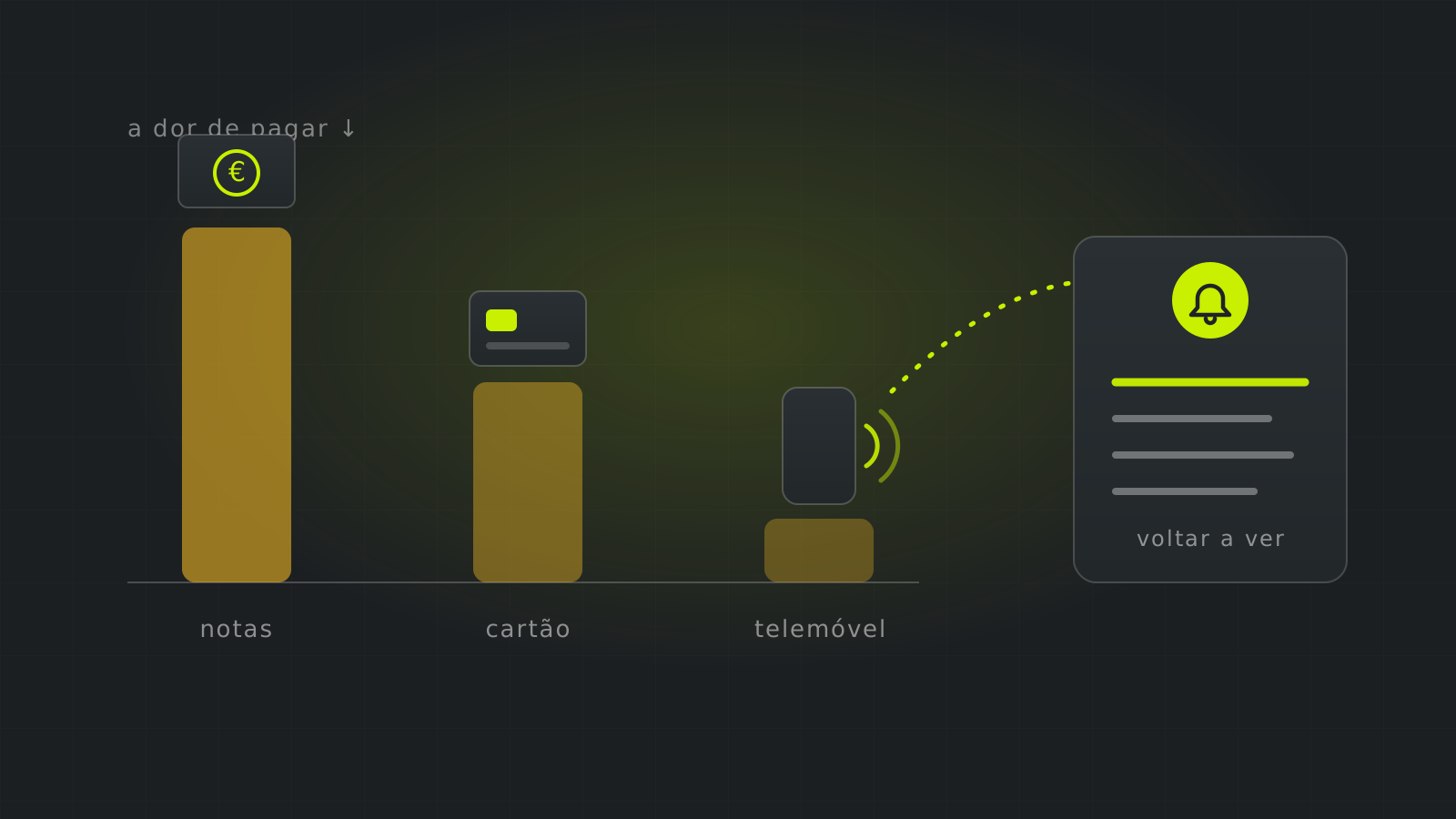
Behavioural economics gave a name to what disappeared in that gesture. In the 1990s, researchers at Carnegie Mellon and MIT began studying the «pain of paying»: the real, almost physical discomfort we feel the moment money leaves us. In 1998, Drazen Prelec and George Loewenstein formalised the idea in the paper The Red and the Black: the pleasure of consuming and the pain of paying live in a double-entry mental account, where each dampens the other — which is why a taxi meter ticking upward ruins the ride [1]. And the intensity of the pain depends on the «coupling» between payment and consumption: "credit cards tend to weaken the coupling, while payment in cash produces strong coupling" (free translation) [1]. In other words: the less you see the money leaving, the less it costs to spend it.
The effect isn't subtle. In 2001, Prelec and Duncan Simester ran a sealed-envelope auction for real NBA basketball game tickets among MIT students: some would pay in cash, others by credit card. The conclusion was published under a title that plays on the American Express slogan — Always Leave Home Without It: "willingness-to-pay can be increased when customers are instructed to use a credit card rather than cash. The effect may be large (up to 100%)" [2]. The same people, the same ticket, bids up to double — just because the means of payment changed.
A decade of making money invisible
What was a lab experiment in 2001 is now the default system across a continent. The European Central Bank regularly measures how consumers in the euro area pay, and the 2024 SPACE study traces the curve: cash accounted for 79% of in-store payments in 2016; by 2022 it was 59%; by 2024, 52% — and mobile phone payments nearly doubled since 2022, reaching 6% of transactions [3]. Online purchases, where physical cash doesn't even enter the picture, already make up 21% of day-to-day transactions (36% by value) [3].
Portugal has its own version of this story, with a name of its own. MB WAY (Portugal's mobile payment app) turned ten in October 2025 with more than 6.5 million users [5]. Vítor Fernandes, chairman of the Board of Directors of SIBS (the operator of Portugal's interbank network), marked the date by recalling that "ten years ago, MB Way started a new era in payments in Portugal" and that today "MB Way is part of the life of the Portuguese — in shopping, in splitting bills between friends, in charitable donations and in the small decisions of everyday life" [5]. That's true — and that's exactly the point. When paying becomes as much a part of life as breathing, the moment where you notice you're paying stops existing.
Nobody wants to go back (nor should they)
Let's be clear about this: this isn't a manifesto against contactless. Convenience is a real gain — for those paying, for those selling, for the economy. The ECB itself, when publishing the 2024 SPACE study, insisted that the goal is to preserve choice, not to halt digitalisation. In the words of Piero Cipollone, member of the Executive Board: "We are dedicated to ensuring secure, efficient and inclusive payment options. By supporting both cash and the development of a digital euro, we want to guarantee people can always choose to pay with public money, now and in the future" [4]. As for the rest, Europeans remain attached to physical cash as an option — 62% consider it important to keep it [3] — but they're using it less and less.
The problem, then, isn't that friction disappeared. Friction was never a virtue; it was a side effect with a hidden benefit: it forced you to notice. Prelec and Loewenstein identified this dilemma almost thirty years ago — there's a tension between hedonic efficiency (paying without suffering) and decision efficiency (keeping a real sense of costs) [1]. Collectively, we chose to stop suffering. What's left to solve is the second half: how to keep the sense of it.
If the pain left the gesture, awareness has to come from somewhere else
This is where financial management apps come in — as a category. If the moment of payment no longer leaves a mark on your memory, the record has to happen somewhere else: automatic, complete, not dependent on your discipline. It's no accident that these tools grew exactly in the decade when money became invisible — they're the functional answer to a problem that the payments system itself created. The logic is to replace pain in the moment, which isn't coming back, with continuous visibility: every tap on the terminal shows up somewhere with a name, a category and a consequence for your balance at the end of the month.
How AtivaMoney gives you back what the beep doesn't tell you
AtivaMoney was designed for this world — the world of payments you don't feel:
- Record without memory. Every transaction — contactless, MB WAY, direct debit — enters the app on its own. Nothing depends on you remembering to note it down.
- Categorisation that learns with you. The AI classifies your transactions based on your patterns — the coffees, the food delivery, the subscriptions — so you can see exactly where your invisible money is going.
- Balance projection and alerts. Instead of discovering the damage on the 28th, you see today how the month will end if you keep up the same pace — and you get alerts when a category speeds up.
- Tags and context. Tag spending by project or life moment («holiday», «home renovation») and see the pattern behind the taps on the terminal.
- No hidden trade-offs. The business model is the subscription: your data is used to give you visibility — not for advertising.
Checklist: pay without friction, spend with awareness
- Turn on payment notifications. The terminal's beep doesn't tell you the day's total — notifications from your bank or your management app give you back the «mental receipt» the gesture stopped providing.
- Review the day in 30 seconds. At the end of the day, scroll through the list of what went out. It's not accounting; it's re-coupling: reconnecting each expense to the decision that created it.
- Budget the invisible categories. Coffees, food deliveries, apps, micro-purchases: these are the painless expenses that grow the most. Give them a monthly limit and track it.
- Create a 24-hour rule. For unplanned purchases above a value you define, wait a day. The distance restores the deliberation that «one click» removes.
- Get ahead of the month instead of performing an autopsy on it. On the 1st, look at the projection: how much comes in, how much is committed, how much is left over. Don't react. Get ahead.
Money has become invisible, and it isn't going to become visible again. Your awareness is what decides whether it disappears along with it. The right tools don't ask you to start feeling pain when you pay again — they ask you for thirty seconds of attention a day. That's a better trade than the one you used to make with your change.
References
- D. Prelec, G. Loewenstein — The Red and the Black: Mental Accounting of Savings and Debt, Marketing Science 17(1), pp. 4–28, 1998
- D. Prelec, D. Simester — Always Leave Home Without It: A Further Investigation of the Credit-Card Effect on Willingness to Pay, Marketing Letters 12(1), pp. 5–12, 2001
- Banco Central Europeu — Study on the payment attitudes of consumers in the euro area (SPACE) — 2024, dezembro de 2024
- Banco Central Europeu — Digital payments continue to rise, albeit at a slower pace; cash remains a key payment method (comunicado, declarações de Piero Cipollone), 19 de dezembro de 2024
- Jornal Económico — MB Way faz 10 anos e acumula mais de 6,5 milhões de utilizadores (declarações de Vítor Fernandes, SIBS), outubro de 2025
This article was translated from the Portuguese original.