
For many couples in Portugal, the first big financial decision isn't where to invest — it's whether the bank account has one name on it or two. It looks like a practical choice, almost an administrative one. Research in behavioural economics and family studies says otherwise: it's one of the decisions that weighs most heavily on the long-term health of a relationship.
A study of 4,574 American couples, published in 2012 in the academic journal Family Relations using longitudinal data from the National Survey of Families and Households, found that money arguments are the strongest predictor of divorce — stronger than arguments about children, in-laws or sex, and regardless of the couple's income, debt or net worth [1]. According to Sonya Britt, co-author of the study and assistant professor of Family Studies at Kansas State University, “Arguments about money is by far the top predictor of divorce. It's not children, sex, in-laws or anything else. It's money — for both men and women.” [2] According to the researcher, money arguments also take longer to resolve and tend to be more intense than other types of conflict [2].
It makes sense, then, that hiding money from a partner is particularly corrosive. A 2023 survey conducted by OnePoll for the British law firm Weightmans, of 2,000 people, found figures that might surprise: 38% of couples admit to some form of “financial infidelity” — hiding accounts, cards or debts from their partner —, 24% have no idea at all how much their partner earns, and almost 1 in 10 has more than £1,000 tucked away in secret savings [3]. As Emma Collins, National Head of Services for Individuals and Families at Weightmans, sums it up, “This deception not only breaches the trust upon which relationships are built but may also result in legal disputes, particularly when large sums or significant debts are involved without one partner's knowledge.” [3]
Science's unexpected answer: pool everything?
Against this backdrop of conflict and secrecy, a recent body of research has suggested something that goes against most people's intuition: couples who fully pool their finances into a single account seem to argue less about money and stay together longer.
The strongest evidence comes from an experiment published in 2023 in the Journal of Consumer Research, conducted by Jenny Olson (Indiana University), Scott Rick, Deborah Small and Eli Finkel. Over two years, the researchers randomly assigned 230 couples who were engaged or newly married to three conditions: opening a joint account, keeping separate accounts, or choosing freely. Couples in the “separate accounts” and “no intervention” conditions showed the usual decline in relationship quality over the first two years of marriage; those assigned to the joint account maintained high relationship quality throughout the period [4]. According to Jenny Olson, assistant professor of Marketing at Indiana University's Kelley School of Business, “When we surveyed people of varying relationship lengths, those who had merged accounts reported higher levels of communality within their marriage compared to people with separate accounts, or even those who partially merged their finances.” “They frequently told us they felt more like they were ‘in this together.’” [4]
A second body of research, by Joe Gladstone (University College London), Emily Garbinsky (University of Notre Dame) and Cassie Mogilner Holmes (UCLA Anderson), analysed data from the British Cohort Study covering more than 7,500 participants in committed relationships — an average of 12 years married, 75% with children. Couples with fully shared finances reported relationship satisfaction of 6.10 on a scale of 1 to 7, against 5.82 for those who partially shared and 5.46 for those who kept everything separate; over ten years, 24% of couples with fully shared finances split up, against 30% of those who kept everything separate [5]. As Emily Garbinsky put it, “There's initial evidence that pooling finances creates a sense of togetherness.” “You see you and your partner as one, having more common financial goals.” [5]
Pooling everything isn't the only answer — or always the best one
Before you rush to close your personal account, there are two important caveats. The first: the numbers above are averages — partial merging (one shared account for joint expenses, individual accounts for everything else) already delivers most of the benefit of togetherness, without requiring the total loss of financial autonomy that bothers a lot of people, especially after previous relationships or when the couple's incomes are very different. The second: merging accounts without matching visibility can reproduce, inside the couple, an imbalance that research has already identified at another level. A 2023 OECD report on the gender gap in financial literacy notes that, within couples, it's more often the man who takes on the role of household “financial representative” — which, according to the OECD, helps explain why women continue, on average, to score lower on financial literacy: whoever doesn't manage day-to-day finances has less opportunity to practise and less preparation for decisions such as their own retirement [6].
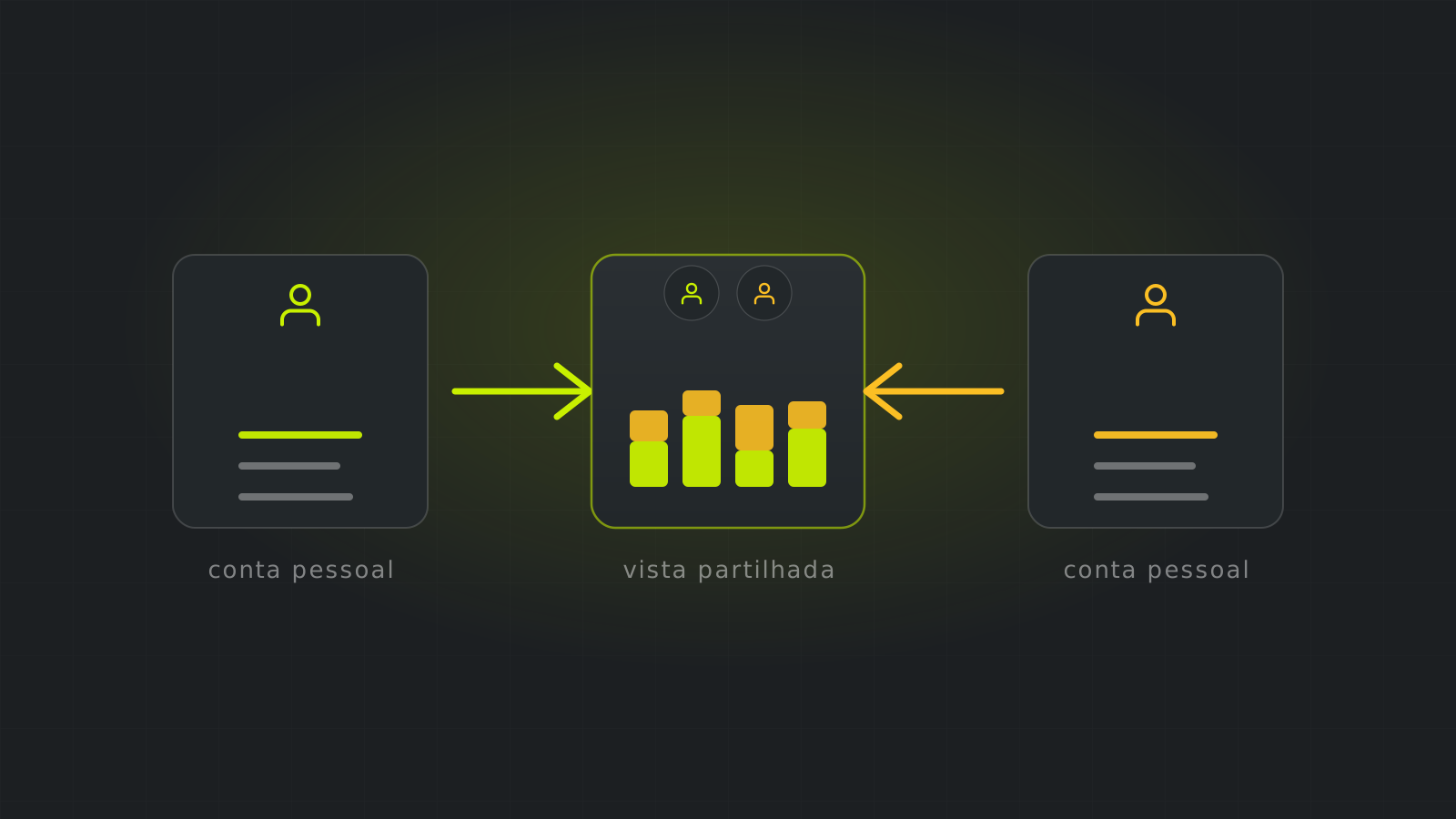
In other words: what protects the relationship isn't technically “having one account instead of two” — it's shared visibility over the couple's money, whatever account structure is chosen. This is where financial management tools come in, as a category: they exist to give either member of a couple a complete, real-time view of their shared financial picture, without forcing anyone to give up a personal account or an individual receipt.
How AtivaMoney fits in
We designed AtivaMoney with exactly this balance between sharing and autonomy in mind:
- Shared wallets with permissions: you invite your partner to view — or view and edit — specific accounts and categories, without having to move money around or merge banks.
- Symmetrical visibility: both members of the couple see the same dashboard, the same goals, the same history — no more single “financial representative” who knows everything while the other guesses.
- Shared goals, separate accounts: you set goals together (emergency fund, holidays, house deposit) without touching anyone's personal account.
- Honesty about what's missing: a Family plan, with more granular permissions per household member, is on the way — we don't promise what doesn't exist yet, but we're building today what will support it tomorrow.
5 steps to talk about money as a couple without drama
- Schedule a 20-minute monthly “money meeting”, outside of crisis discussions, with the date set in advance.
- Decide now which expenses are shared (rent, bills, groceries) and how they're split — proportional to income tends to generate less resentment than a straight 50/50 split when incomes differ a lot.
- Keep an individual “allowance” with no questions asked — even with shared finances, everyone needs money that doesn't require justification.
- Share visibility before you share accounts — seeing the same dashboard resolves more arguments than merging banks.
- Revisit the decision at every major life change — marriage, a child, buying a home. What worked for two might not work for three.
Science doesn't say there's a single right way to organise money as a couple. It says secrecy and opacity come at a cost — and that togetherness, whatever account structure supports it, protects the relationship. The question isn't “joint or separate?” — it's “do you both see the same thing?”
Frequently asked questions
Joint or separate accounts: what do the studies say?
A study of 4,574 couples found that money arguments are the strongest predictor of divorce. More recent research suggests that couples who fully pool their finances argue less about money and stay together longer: in the British Cohort Study, 24% of couples with fully shared finances split up, against 30% of those who kept everything separate.
Is merging accounts always the best option?
Not always. The numbers are averages: partial merging — one shared account for joint expenses and individual accounts for everything else — already delivers most of the benefit of togetherness without requiring the total loss of autonomy. What protects the relationship isn't having one account instead of two, but shared visibility over the couple's money.
How does AtivaMoney help couples manage money?
With shared wallets and permissions: you invite your partner to view, or view and edit, specific accounts and categories, without moving money or merging banks. Both of you see the same dashboard and the same goals (symmetrical visibility), and you set goals together without touching anyone's personal account.
References
- Jeffrey Dew & Sonya Britt-Lutter — Examining the Relationship Between Financial Issues and Divorce, Family Relations, 61(4), 2012
- Kansas State University (via ScienceDaily) — Early financial arguments are a predictor of divorce, 12 de julho de 2013
Arguments about money is by far the top predictor of divorce. It's not children, sex, in-laws or anything else. It's money — for both men and women.
- Weightmans — Financial infidelity across the UK (inquérito OnePoll, n=2.000), 2023
This deception not only breaches the trust upon which relationships are built but may also result in legal disputes, particularly when large sums or significant debts are involved without one partner's knowledge.
- Indiana University (IU News) — Married couples who merge finances may be happier, stay together longer, 4 de maio de 2023; estudo publicado na Journal of Consumer Research (Olson, Rick, Small & Finkel)
When we surveyed people of varying relationship lengths, those who had merged accounts reported higher levels of communality within their marriage compared to people with separate accounts, or even those who partially merged their finances. They frequently told us they felt more like they were 'in this together.'
- UCLA Anderson Review — Research Brief: pooling finances and relationship satisfaction (Gladstone, Garbinsky & Mogilner); citação de Emily Garbinsky via Mendoza Business Magazine, Universidade de Notre Dame, outono de 2019
There's initial evidence that pooling finances creates a sense of togetherness. You see you and your partner as one, having more common financial goals.
- OCDE — Joining Forces for Gender Equality — Gender differences in financial literacy and resilience, 2023
This article was translated from the Portuguese original.